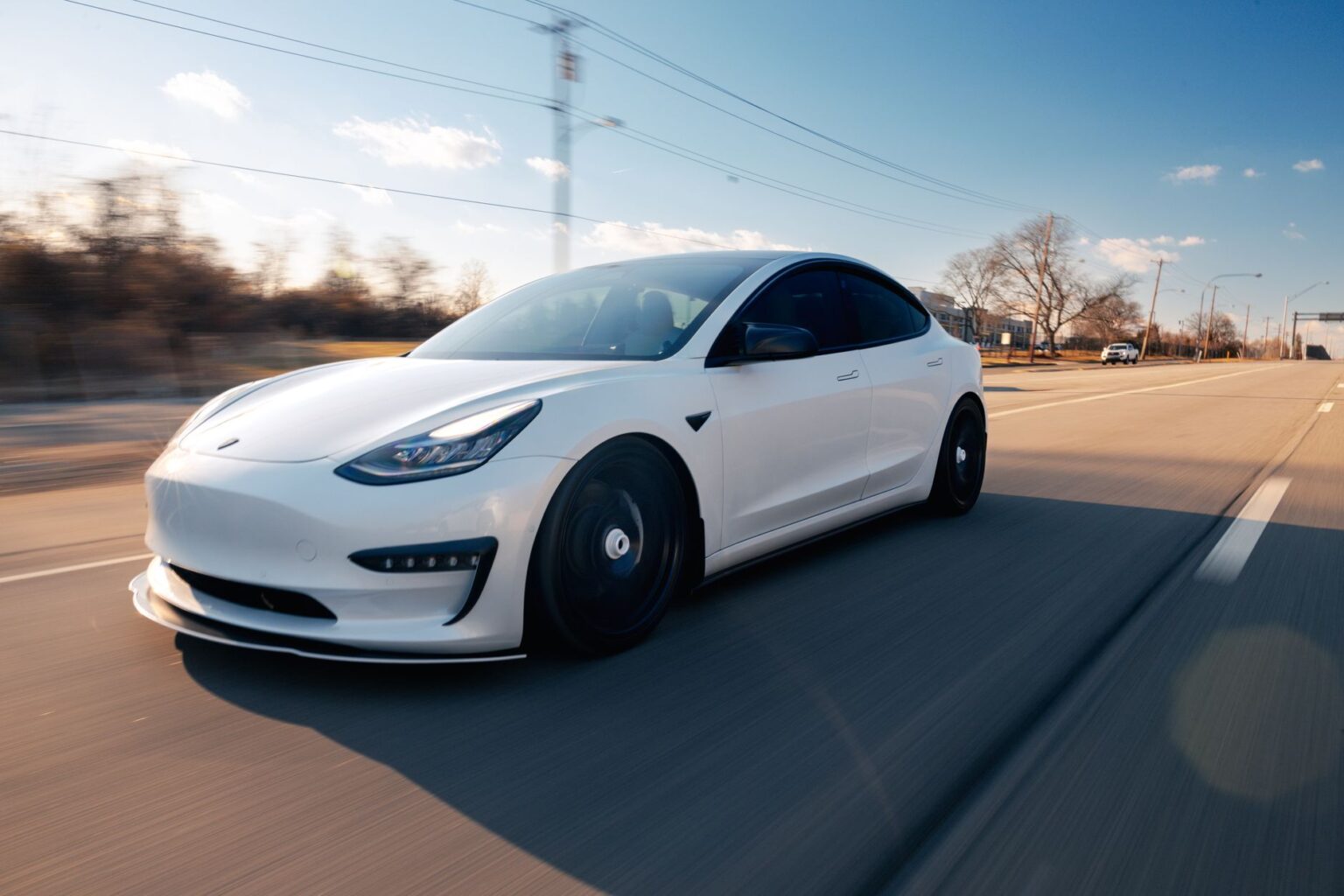
Every mile per hour you add on the highway costs more range than the last one. That’s not a Tesla quirk — it’s aerodynamics. Tesla’s own range guidance puts it plainly: energy from speed is proportional to the square of speed, so doubling your speed can require up to four times as much energy per mile. On a road trip, that math is the difference between a comfortable margin at your next Supercharger and cutting it close.
What a real speed test shows
A March 2026 test by Carscoops, driving a single-motor, rear-wheel-drive Tesla Model Y at a series of constant speeds, put numbers to the effect. At 50 mph, the car used 224.7 Wh per mile, good for a calculated 333 miles of range. Push that to 60 mph and range dropped to 300 miles. At 70 mph, consumption jumped to 302.2 Wh per mile and range fell to 248 miles. At 80 mph, efficiency fell further still, to 366 Wh per mile, cutting range to just 204 miles — about 39% less than the 50 mph figure, even though the car covers the same distance in far less time.
The tester’s conclusion: the sweet spot for most drivers sits between 60 and 70 mph. Slowing from 70 to 60 mph added roughly 40 minutes to a 300-mile trip in that test but bought back about 30 miles of range — often enough to skip an extra charging stop entirely.
Why the drop isn’t linear
Aerodynamic drag is the main culprit, and it scales with the square of your speed, so the penalty gets steeper the faster you go. That’s why the jump from 70 to 80 mph in the Carscoops test cost far more range than the jump from 50 to 60 mph, even though both are 10-mph increases. Tire rolling resistance and increased motor load add to the effect, but drag dominates once you’re above about 50 mph.
This is also why your Tesla’s rated range and trip-planner estimate can diverge from what you see on a fast-moving interstate: EPA range ratings are built from mixed driving cycles that include lower-speed segments, not sustained 75-80 mph highway cruising.
How to use this on a road trip
You don’t need to hypermile to benefit from this. A few practical takeaways:
Dropping your cruising speed by 5-10 mph on a long highway stretch, especially when you’re already watching your charge margin heading into a Supercharger stop, can meaningfully stretch your remaining range without adding much time. Cruise control or Tesla’s built-in Speed Assist can help you hold a steady, efficient speed rather than drifting faster over a long stretch. And if your trip planner shows a tight margin between stops, the fix is often not a longer charging session — it’s a slightly slower final few miles.
None of this means driving 80 mph is off-limits. It means knowing the tradeoff going in: on a Tesla, every 10 mph above roughly 60-65 mph buys you a shorter drive and a real bite out of your range, and the bite gets bigger the faster you go.
Photo by Matt Weissinger.