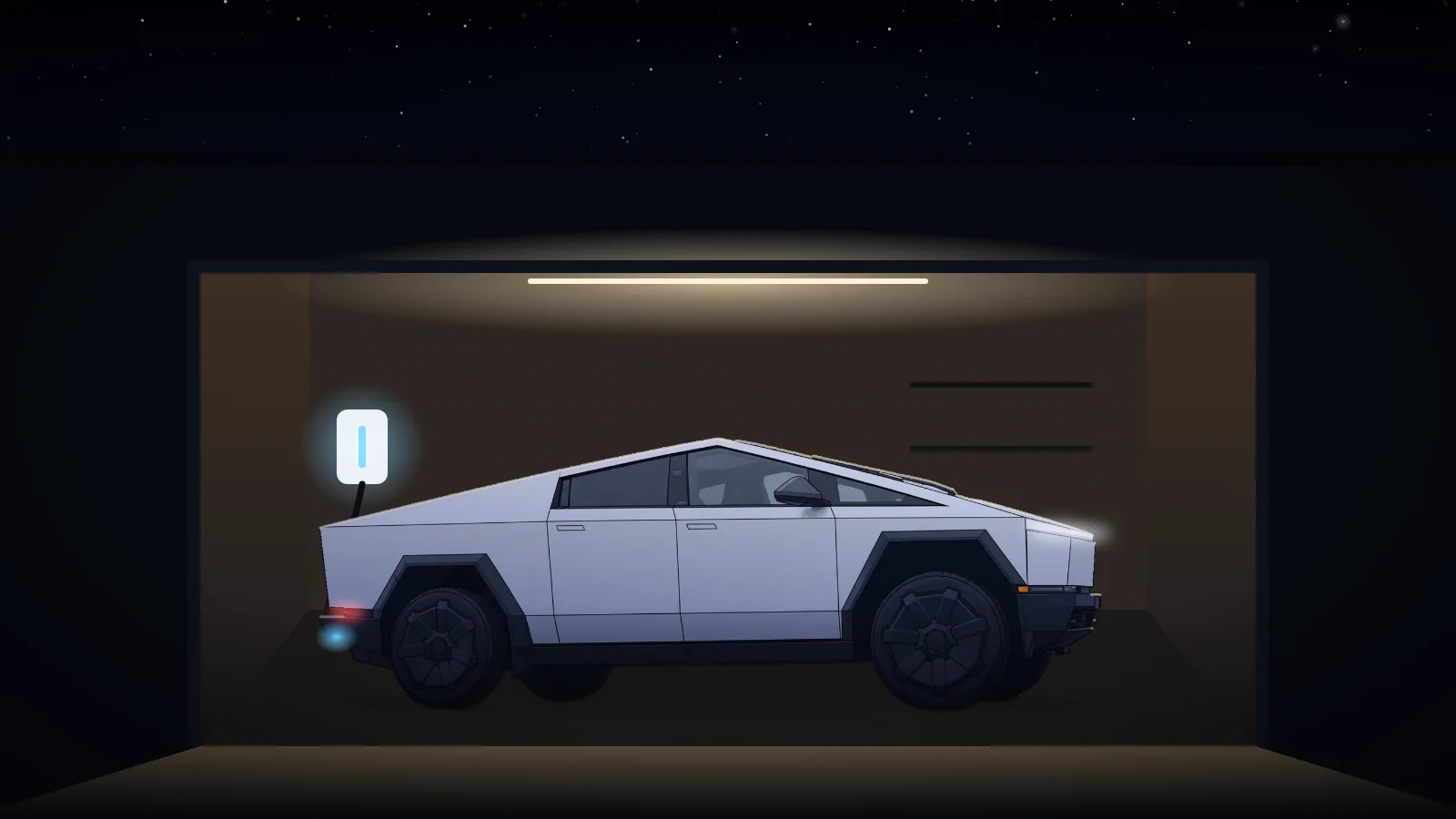
Every new Tesla ships with a Mobile Connector, a portable charging cable that plugs into a wall outlet. Many owners eventually add a dedicated, hardwired charger instead. Both approaches use what’s called Level 2 charging, which runs on a 240-volt circuit, the same voltage as a clothes dryer, and charges much faster than a standard 120-volt household outlet. Here is how the two options compare and how to decide which one fits your home.
The Mobile Connector that comes with your car includes an adapter for a standard 120-volt outlet and a second adapter for a 240-volt outlet often called a NEMA 14-50, the same style of outlet used for RV hookups and some electric ranges. On a regular 120-volt household outlet, Tesla states you can expect to add about 3 miles of range per hour. Plugged into a 240-volt NEMA 14-50 outlet instead, the same cable adds roughly 23 to 30 miles of range per hour, depending on your model.
A dedicated Level 2 wall charger, such as Tesla’s Wall Connector, is wired directly into your home’s electrical panel instead of plugging into an outlet. Tesla’s Wall Connector can deliver up to 48 amps, or 11.5 kW, of power, adding up to 44 miles of range per hour for most models. Third-party Level 2 chargers work the same way. InsideEVs reports that most current Level 2 chargers output 48 to 50 amps, now the standard for most electric vehicles, and that some higher-capacity chargers reach 80 amps for vehicles built to use that much power.
Amperage determines both charging speed and what your home’s electrical system needs to support it. Tesla’s Wall Connector can be configured anywhere from 12 to 48 amps, so an electrician can dial it down to fit a smaller available circuit if your panel doesn’t have room for the full 48-amp setup. You’ll charge more slowly, but you avoid a bigger, more expensive circuit. The Mobile Connector on a 14-50 outlet tops out lower than a fully configured Wall Connector, which is usually enough for overnight charging but slower if you drive a lot of miles each day.
Installing either a new 240-volt outlet or a hardwired wall charger involves similar steps. InsideEVs recommends hiring a licensed electrician, ideally one experienced with EV charging installations, because the job requires a load calculation to confirm your home’s panel can handle the added draw, and inexperienced electricians may not know current code requirements. Most local building departments require a permit for a new 240-volt circuit, and the same source advises pulling one so the work gets inspected. Your electrician will check whether your panel has enough spare capacity, sometimes called ampacity, for the new circuit. If it doesn’t, you may need a panel upgrade, which adds to both the cost and the timeline.
Tesla’s own pricing page gives a starting point for budgeting. Tesla lists the Mobile Connector at $300, with installation of a new outlet costing $0 to $1,500 depending on how much electrical work is needed. The Wall Connector costs $535, with typical installation running $750 to $1,500, and the Universal Wall Connector, which adds a plug usable by non-Tesla EVs, costs $600 with similar installation pricing. Actual cost depends heavily on the distance between your panel and where you park, and whether your panel needs upgrading.
Which option fits depends on your setup. If your garage already has a 240-volt outlet from a dryer, welder, or RV hookup, plugging in the Mobile Connector you already own is the cheapest way to start home charging right away. If you don’t have one, drive well over 30 miles a day, or plan to keep the car for years, a hardwired Wall Connector is usually worth the extra upfront cost. Tesla itself recommends the Wall Connector as its preferred solution for regular home charging, since it’s built for daily use and charges faster than a portable cable. Either way, this is informational only; get a quote from a licensed electrician who can inspect your specific panel before you commit to equipment or installation costs.